
EMOTIONAL REGULATION ISN’T WHAT YOU THINK IT IS
Share to:

Content Warning:
This post discusses emotional abuse, manipulation, and trauma responses. Please read with care.
Disclaimer:
This is a personal account of my experiences, written from my perspective and memory. Names and identifying details have been changed or omitted to protect privacy. This is not intended to defame any individual, but to share my healing journey and help others recognise unhealthy patterns in their own lives.
There’s a particular feeling that happens in your chest when someone is trying to make you doubt your own reality. A tightness. A panic. Your nervous system screaming: back down, apologise, make it stop. For years, I always did. Until the day I didn’t.
I looked at her and said: “You either have feelings for me, or you’ve been gaslighting me for 16 years.”
I wasn’t asking. I was naming what I knew to be true.
Her response came fast: “I can’t believe you think I was gaslighting you.”
She kept saying it. My chest tightened. My body wanted to fold. Every cell screamed take it back, soothe her, make this stop. The urge to fawn was overwhelming – 16 years of conditioning doesn’t disappear just because you’ve done some healing work.
But this time, I stayed in my body.

Photo credit: Viktor Talashuk
What I Would Have Done Before
A year earlier? I would have immediately backtracked. “No, I’m sorry – I didn’t mean it like that. I know you weren’t trying to hurt me.” I would have made myself smaller, twisted my words into something less threatening, and spent the next hour reassuring her that I wasn’t accusing her of anything.
I would have abandoned my truth to manage her feelings.
What Happened When I Didn’t React
The silence stretched. She kept repeating herself, waiting for me to fold.
She didn’t attack directly – she was smarter than that. She started playing games. Her energy changed. Testing. Probing. Looking for the angle that would destabilise me.
I’d learnt to recognise this pattern. The subtle escalations designed to provoke a reaction. Sometimes it was threats that seemed almost casual – the kind you couldn’t quite call out without looking paranoid. Sometimes it was implications about what it would take for things to be “different” between us.
Each time, she was watching. Waiting to see if she could make me break.
Staying In My Body
But I’d been practising. Not practising “staying calm” – practising staying present.
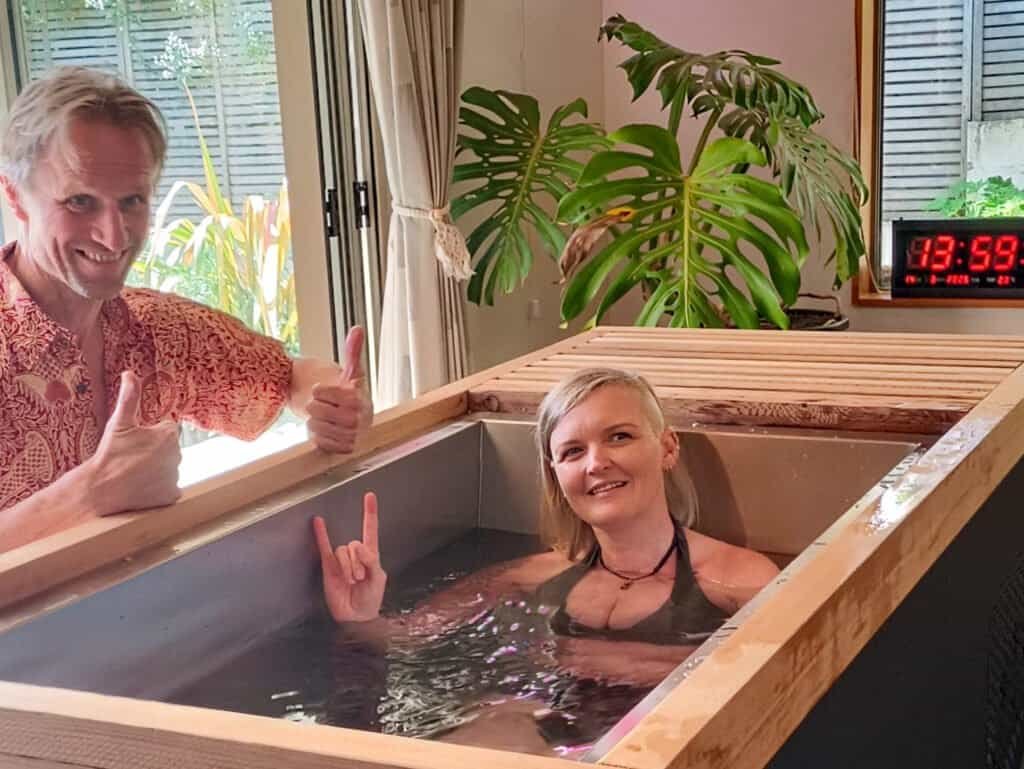
I had been cold showering every day. The cold had taught me that I could stay with discomfort without running from it.
And in moments like this, I’d repeat to myself: stay in your body.
I focused on my breath. Not controlling it, just noticing it. The sensation of air moving through my body. The weight of my body on the floor.
When it got too intense – when the pressure felt unbearable – I’d throw myself into the ocean. I let the shock of the cold reset my nervous system.
I didn’t try to make the discomfort go away. I went into it.

Photo credit: Jennifer Lim-Tamkican
The Environment Around Her
It wasn’t just her dysregulation I was navigating. It was the entire environment.
She had people who would carry messages and report back. I had played that role myself before and could see what was happening. They didn’t know they were being used and I knew exactly how this worked.
I had devoted myself entirely to what she was creating, often for little or nothing in return, and I was captivated by the possibility of helping people. It gave me a sense of purpose that I desperately needed.
She wasn’t alone in this. She relied on someone for advice – someone who had positioned himself as a spiritual mentor. His influence seemed to shift how she saw what was happening between us, and the tactics would change unpredictably depending on what she was being fed.
Staying in my body wasn’t just about managing one person’s dysregulation. It was about staying centred whilst navigating an entire web of nervous systems – all triggering each other, all trying to pull me back into the chaos.
The cold showers taught me I could stay present through discomfort. But this taught me I could stay present through chaos – when the ground kept shifting beneath me and I couldn’t predict what was coming next.
I stopped seeking validation from the people around me. Their perspectives were clouding my clarity, pulling me further from what I knew to be true.
And I had to remain silent because reacting would have played right into the trap. Any defence, any explanation, any emotional response would have been used as evidence that I was the problem.
I had to learn to listen to myself. To trust what my body was telling me, even when everyone around me was reflecting a different reality back.
And I had to trust that my closest friends would see through it. That the people who truly knew me wouldn’t need me to defend myself or prove what was happening. They would just… know.
That kind of trust – in yourself, in the few people who can actually see clearly – that’s what staying in your body requires.

Photo credit: Jakob Owens
What Emotional Regulation Actually Is
Emotional regulation is the ability to stay present with what you’re feeling – without being consumed by it, and without trying to make it go away.
Emotional regulation isn’t suppressing emotions or pretending you’re fine. It isn’t rising above or being spiritual enough that nothing bothers you. It’s feeling the panic rising without immediately trying to stop it. It’s noticing the urge to fawn, flee, or freeze – and choosing how you respond.
For years, I thought I was emotionally dysregulated because I felt things intensely. But feeling intensely isn’t dysregulation. Abandoning yourself to manage someone else’s feelings – that’s dysregulation. Running from discomfort instead of staying with it – that’s dysregulation.
Emotional regulation is staying in your body when everything in you wants to leave it.
What Changed When I Could Stay
When I stopped reacting I could finally see clearly.
When you’re constantly hypervigilant, you can’t think straight. You can’t discern what’s real. You’re just surviving moment to moment, reacting to whatever’s in front of you.
But when I could stay present – even whilst chaos was happening around me – I could see the pattern. I could see what was actually happening instead of what I was being told was happening. I could feel the difference between love and control.
Staying in my body gave me access to information my nervous system had been hiding from me. The truth I’d been too dysregulated to recognise.

Photo credit: Dingzeyu Li
Why Embodiment Matters
Most people don’t realise they’re living outside their bodies until they learn to come back to it.
It’s like breathing short and shallow for so long you forget what a full breath feels like – until someone reminds you to breathe deeply and you realise how starved for oxygen you’ve been.
Disembodiment is the same. You’re so used to living in your head that you don’t realise you’ve completely lost connection to what your body is trying to tell you.
Your body knows when something isn’t safe. It knows when the dynamic is pulling you out of regulation. It knows the difference between love and control.
But if you’re not in your body, you can’t access that information. You’ll rationalise away the discomfort, explain away the red flags, convince yourself that what you’re feeling isn’t real.
This is why people stay in situations that are destroying them.
I was emotionally exhausted. Spiritually depleted. The constant effort of staying present whilst everything around me was designed to pull me out of my body – it took everything I had.
Cold showers. Meditation. Breathwork. Stoicism. The ocean. These were survival tools. They taught me how to stay in my body when every instinct told me to leave it.
And staying in my body is what set me free.
Anna Roters
Your body has been holding the truth this entire time.
If you’re ready to start listening, join us.